Gone Gill and Guts: The Last Fishmongers and the High Street That Turned Its Back on Them
We are surrounded by sea. Let that sink in for a moment. Britain sits in some of the most productive fishing waters on the planet — the North Sea, the Atlantic shelf, the rich cold currents off Scotland and Cornwall — and yet the average British consumer's relationship with fresh fish now consists entirely of a supermarket visit, a polystyrene tray, and a sell-by date that requires no further thought.
Somewhere between the 1970s and now, we lost the plot entirely. The independent fishmonger — once as fundamental to a British high street as the baker or the butcher — has been quietly and comprehensively eliminated. There were an estimated 10,000 independent fishmongers operating in Britain at the end of the Second World War. Today, estimates put the number at somewhere below 500. Many of those that remain are clinging on by their fingernails.
This is not just a retail story. It is a story about expertise, about seasonality, about what it actually means to eat fish — and about a convenience culture so total that we've accepted a frozen, pre-portioned, vacuum-packed substitute as the normal state of affairs.
What a Proper Fishmonger Actually Does
If you've never used an independent fishmonger, it's worth understanding what you've been missing. It is not simply a shop that sells fish. It is a repository of knowledge accumulated over years, often decades, of direct relationships with boats, markets, and the sea itself.
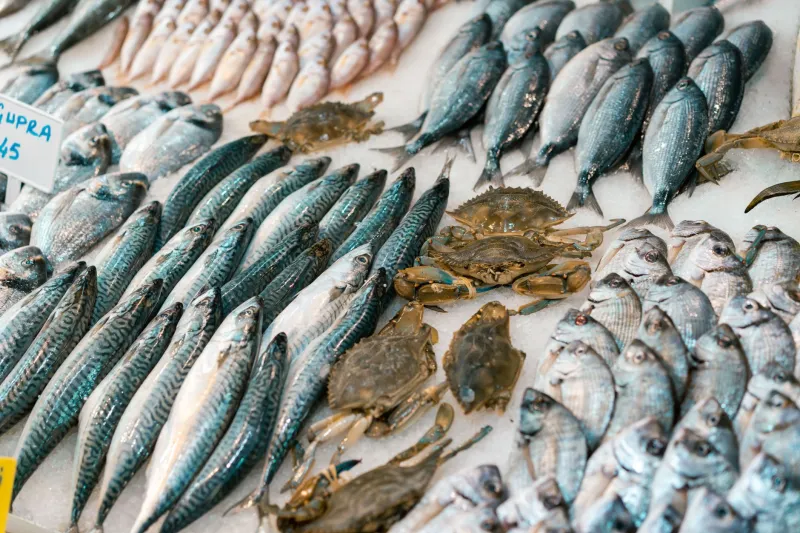
A good fishmonger knows what came in that morning. They know which boat it came off, which waters it was pulled from, and how long it's been out of the water. They can tell you whether the mackerel is worth buying this week or whether the haddock is the smarter call. They will fillet a plaice in front of you in forty-five seconds, remove the pin bones from a salmon without being asked, and tell you that the gurnard sitting in the corner of the display — cheap, underrated, and magnificent in a stew — is actually the best thing on the slab today.
None of this exists in a supermarket. What exists in a supermarket is a refrigerated cabinet, a rotating selection of the same six species (salmon, cod, haddock, tuna, prawns, and whatever they're calling "sustainable white fish" this week), and a complete absence of anyone who can tell you anything useful about any of it.
The Men and Women Still Standing
Mike Chalmers has been a fishmonger in Aberdeen for thirty-one years. His shop, a short walk from the city's covered market, opens at half six in the morning and sometimes sells out by noon. He buys direct from the harbour, knows the skippers personally, and has never once stocked frozen fish.
"People ask me why I don't do frozen," he says, with the weary patience of a man who has answered this question many times. "I tell them I don't need to. If it's fresh, it sells. The problem is that people have forgotten what fresh actually means. They've been eating defrosted supermarket fish for so long they think that's normal."
Chalmers has watched eight fishmongers close within a ten-mile radius of his shop over the past two decades. Rising rents, supermarket competition, and the collapse of the daily fish-buying habit among younger consumers have done for most of them. He's survived by being irreplaceable — by offering something the supermarkets structurally cannot replicate.
Down in Brixham, Devon, Fiona Trelawney runs a stall at the covered market three days a week, buying off the quay at one of Britain's busiest fishing ports and selling to a loyal local following that has kept her going for fourteen years. "The tourists think it's quaint," she says, not without some edge. "The locals know it's just how fish should be sold."
Both of them tell similar stories: a core of loyal, older customers who grew up with fishmongers; a slow trickle of younger converts who've discovered them through farmers' markets or food writing; and a vast middle ground of potential customers who've simply never considered the alternative.
How Convenience Killed the Counter
The supermarkets didn't set out to destroy the fishmonger trade. They simply did what they do — offered a product that required less effort from the consumer, wrapped it in clean packaging with clear labelling, and made it available alongside everything else in the weekly shop.
The problem is that fresh fish is fundamentally incompatible with the supermarket supply model. It doesn't last long enough, it varies too much by season and catch, and it requires human expertise to sell properly. So the supermarkets solved this problem by removing the freshness. Pre-freezing, pre-portioning, and extended shelf-life processing mean that the fish you buy in a supermarket might be weeks removed from the water by the time it reaches your trolley, even if it's technically sold as "fresh."
The consumer, never having been told otherwise, accepted this. And in accepting it, lost the reference point that would have told them something was wrong.
Seasonal eating — the idea that you might eat herring in autumn, sea bass in summer, and oysters in months with an R in them — has been almost entirely erased from mainstream British fish consumption. The supermarket offers the same species year-round, sourced globally, with seasonality engineered out of the equation entirely. It's efficient. It's also a form of culinary lobotomy.
What We Owe the Sea
Britain's fishing heritage is extraordinary. From the Grimsby trawlermen to the Cornish crabbers, from the Scottish langoustine boats to the Thames estuary cockle gatherers, this country has a relationship with seafood that runs deeper than most of us currently honour. The independent fishmonger is the retail expression of that heritage — the human link between the water and the table.
Losing them is not just an inconvenience. It is a severance. It means that within a generation or two, the knowledge of how to buy fish, how to read a fresh catch, how to ask the right questions — will be gone entirely. What remains will be polystyrene trays, uniform portions, and the quiet hum of refrigeration units.
Find your nearest independent fishmonger. Use them. Tell someone else. This is not nostalgia — it is the difference between a piece of haddock that actually tastes like the sea and one that tastes like the inside of a freezer bag.
Britain is an island. We should eat like it.