Not All Tins Are Created Equal: The Truth About What's Really in Your Tomatoes
Let's begin with an uncomfortable confession. For years — possibly decades — a significant portion of the British cooking public has been treating tinned tomatoes as a commodity, a background ingredient, something you grab without looking because what difference could it possibly make? It's a tin of tomatoes. They're all the same.
They are not all the same. Not even close. And the gap between the worst and the best is not a minor quibble about nuance — it is the difference between a sauce that tastes of something and a sauce that tastes of slightly acidic water with a vaguely tomato-adjacent memory attached.
We know this because we tasted them. Blind. Eight tins, ranging from the cheapest own-brand to a proper San Marzano DOP, eaten straight from the can and then cooked briefly in identical conditions. The results were not ambiguous.
What Is Actually in a Budget Tin?
The ingredients list on a tin of tomatoes should, in theory, be simple: tomatoes, tomato juice, possibly a pinch of salt and a dash of citric acid to preserve colour. And technically, most budget tins contain exactly that. The problem is not what's in them — it's what the tomatoes themselves are.
Cheap tinned tomatoes are typically made from high-yield processing varieties — tomatoes bred not for flavour but for volume, disease resistance, and the ability to be harvested mechanically. They are watery by nature, with thin flesh, pale seeds, and an acidity that hasn't been balanced by the sugars that develop when a tomato is grown slowly in genuine heat. They are then canned with a significant quantity of tomato juice — itself made from concentrate — which dilutes the product further.
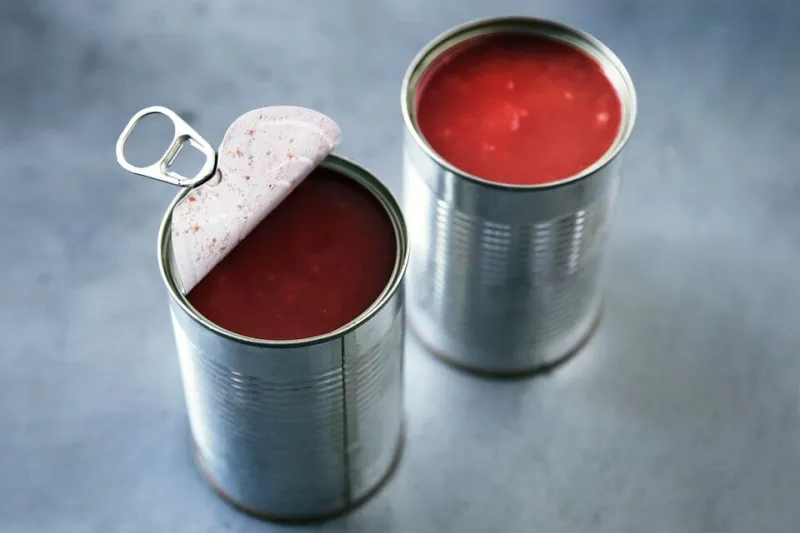
Open a budget tin and look at what you've got: a can that's more liquid than solid, with tomatoes that break apart reluctantly and release a thin, pale pink water. Taste one raw. There's a sourness, a flatness, a faint metallic edge. This is what's going into your bolognese.
The Blind Taste Test: What We Found
We tested eight products across four price brackets, tasting both raw and after a five-minute simmer with nothing added. We're not naming brands in the lower tiers — again, the legal department situation — but the patterns were clear enough to be instructive.
Budget own-brand (under 30p): Watery, sharp, noticeably acidic raw. Cooked, the acidity sharpened rather than mellowed. Thin flavour, slight metallic finish. The tomatoes themselves were soft and textureless. Not unpleasant, exactly, but not really tomato-flavoured.
Mid-range own-brand (30–50p): Marginally better. More tomato solids, slightly less liquid. The flavour was still flat but the acidity was less aggressive. Usable as a background ingredient in something heavily seasoned.
Named Italian brand (60–80p): A noticeable step up. The tomatoes had more structural integrity, the juice was deeper in colour, and the raw flavour had a genuine sweetness behind the acid. Cooked, this produced a sauce with actual character.
San Marzano DOP (£1.50–£2.50): The gap here was not subtle. The tomatoes were meatier, less seedy, and the juice was thick and dark red. Raw, they tasted of actual ripe tomato — sweet, complex, with a rounded acidity. Cooked, the sauce needed almost no adjustment. The flavour was there from the start.
The price difference between the cheapest and most expensive is roughly £2. In the context of a meal for four, that's 50p per person for a sauce that tastes like it was made by someone who cares.
The San Marzano Question
San Marzano is a variety of plum tomato grown in the volcanic soil of the Agro Sarnese-Nocerino region near Naples, and the DOP designation — Denominazione di Origine Protetta — means that the tomatoes carrying that label must be grown there, processed there, and meet specific standards for variety, size, and flesh-to-seed ratio.
This is not marketing. The volcanic soil genuinely produces a different tomato: lower in water content, higher in natural sugars, with a thicker flesh and a more complex flavour profile. The DOP certification is your guarantee that what's in the tin is what it says it is — which matters, because there is an enormous amount of fraudulent or misleading San Marzano labelling in circulation.
If the label says "San Marzano style" or "San Marzano type" or simply "grown in Italy," it is not San Marzano DOP. The genuine article will have the DOP logo and a registration number on the label. Without those, you're buying a name, not a tomato.
How to Read a Tin Label Like a Grown Adult
A few rules that will serve you well in the tinned tomato aisle:
Check the tomato content percentage. Regulations require this to be declared. A tin that's 60% tomatoes and 40% juice is a different product from one that's 90% whole tomatoes. The higher the percentage, the meatier and more flavoursome the contents.
Citric acid is fine; calcium chloride is a flag. Citric acid is a natural preservative. Calcium chloride is added to firm up tomatoes that are already too soft — it's a structural fix for a quality problem.
"Peeled plum tomatoes" versus "chopped tomatoes" matters. Chopped tomatoes are often made from lower-grade fruit — the irregular, damaged, or undersized tomatoes that don't make the cut for whole tinning. This isn't always the case, but it's worth knowing.
Country of origin matters, but isn't everything. Italian tomatoes are not automatically superior — Italian processing of inferior varieties produces inferior tins. But Italian DOP products are subject to meaningful standards that most other origins don't replicate.
When It Doesn't Matter (and When It Really Does)
We are not suggesting you spend £2.50 on every tin you open. There are applications where the budget product is perfectly adequate: a heavily spiced curry base, a long-cooked meat ragu that will be reduced for two hours and seasoned aggressively, a tomato soup that's getting blended and finished with cream and a lot of basil.
But for a quick pasta sauce — the kind you make on a Tuesday when you have twenty minutes and a packet of spaghetti — the quality of the tin is the quality of the dish. There's nowhere for a watery, acidic base to hide when it's carrying the whole flavour. Same goes for shakshuka, for a simple bruschetta topping, for a pizza sauce that isn't going to be buried under toppings.
The rule of thumb: the fewer other ingredients in the dish, the more the tin matters.
The Verdict
Britain has been underselling itself on tinned tomatoes for a long time, and the reason is simple: we've been treating them as a generic ingredient rather than a product with genuine quality variation. The supermarkets haven't helped — the tomato aisle is arranged by price, and the cheapest products are at eye level.
Buy up. Not always, not for everything, but for the dishes where it matters. Your pasta sauce has been trying to tell you something for years. It's time to listen.