Brie There, Done That: Why Britain's Cheese Boards Have Quietly Gone Continental and What We've Lost
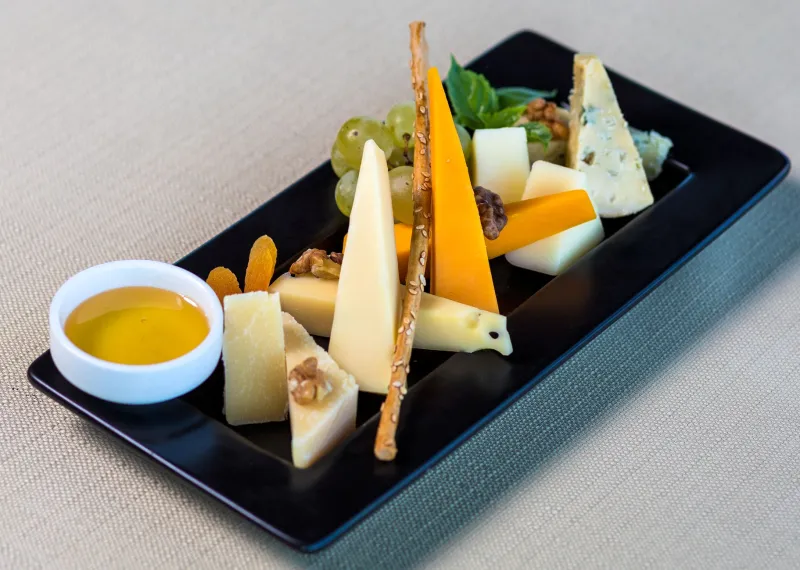
Something peculiar has happened to the British cheese board. Walk into a deli that considers itself serious — the kind with exposed brick, small-batch coffee, and a chalkboard menu that uses the word "artisan" without irony — and you'll find a selection that skews heavily, sometimes entirely, European. A wedge of Comté here, a generous slab of Manchego there, perhaps some Taleggio for the adventurous, a Brie de Meaux for the traditionalists, and if you're very lucky, a token British cheese somewhere at the end, usually a Cheddar, usually a mild one, sitting there like a polite afterthought.
This is presented as sophistication. As broadmindedness. As the natural result of a food culture that has matured beyond its parochial roots and embraced the best the continent has to offer.
It is, with respect, complete nonsense.
Britain makes some of the most extraordinary cheese on the planet. Not competent cheese. Not decent-for-an-island-nation cheese. Genuinely world-class, deeply characterful, irreplaceable cheese — tied to specific landscapes, specific milk, specific centuries-old traditions — and it is being quietly elbowed off its own boards by imported alternatives that are easier to source, easier to explain, and frankly easier to sell to a public that has been taught to associate "French" with "superior" when it comes to anything involving a rind.
The Geography of What We're Missing
Let's be specific, because specificity is the point. While your local deli is stacking shelves with Époisses and Pecorino, these are the British cheeses quietly fighting for survival:
Stinking Bishop — a washed-rind cheese from Gloucestershire, made with perry from Stinking Bishop pears, with a sticky orange rind and an interior so yielding and pungent it makes a grown adult sit down. It briefly became famous after Wallace & Gromit and then, somehow, faded back into obscurity.
Beenleigh Blue — a raw sheep's milk blue from Devon, made seasonally, with a crumble and a sweetness that gives French Roquefort genuine competition and beats it on most days of the week.
Single Gloucester — a protected designation cheese, lighter and more delicate than its Double counterpart, made only from the milk of Old Gloucester cattle and available from precisely a handful of farms. You will not find it in most supermarkets. You will not find it in most delis.
Kidderminster — actually, let's stop listing, because this could go on. The point is that Britain has over 700 named varieties of cheese. Seven hundred. France, for all its fromage-forward reputation, has around 400. We are not a nation lacking in cheese heritage. We are a nation that has forgotten it has any.
How the Continental Drift Happened
The reasons are several, and none of them particularly flattering.
First, the import infrastructure is simply better. European cheese producers — particularly French and Italian ones — have spent decades building the logistics, the marketing, and the trade relationships necessary to get their products onto British shelves efficiently and at competitive prices. Many British artisan cheesemakers are tiny operations, producing small volumes from single farms, with no dedicated sales force and no budget for the kind of trade marketing that gets a product onto a deli counter.
Second, there is the lingering cultural cringe. Britain spent much of the twentieth century being told by food writers, restaurant critics, and various Frenchmen that its cuisine was inferior, its cheeses pedestrian, its palate underdeveloped. Some of that criticism was fair — the mass-produced, plastic-wrapped Cheddar of the 1970s was genuinely dismal — but it stuck far longer than it should have, and it created a reflex among aspirational consumers to reach for the imported option as a signal of taste and education.
Third — and this is the one nobody in the trade likes to say too loudly — imported cheese is often cheaper at wholesale. The economies of scale available to a large Normandy dairy cooperative simply don't exist for a Somerset cheesemaker producing two hundred wheels a month in a converted barn.
The Makers Still at It
Jane Bowyer has been making washed-rind cheeses in Herefordshire for eleven years, selling almost entirely through farmers' markets and a small number of independent delis in the Midlands and Welsh borders. She is cheerful about her situation in the way that people who love what they do and are realistic about its commercial fragility tend to be.
"I don't resent the French cheeses," she says. "They're brilliant. I just think people don't know what's sitting next to them. I take my cheese to a market and people pick it up, smell it, put it down, and go and buy a Brie. And I want to say — try mine first. Just try it."
In Shropshire, a cheesemaker producing a raw cow's milk tomme in the Alpine style — but using milk from a local herd of Dairy Shorthorns grazing on flood-meadow pasture — describes his biggest challenge not as production, but as perception. "People see a British cheese and expect Cheddar or Stilton," he says. "They don't expect something complex and interesting and weird. But we've always made weird cheese here. We just stopped telling people about it."
What a Real British Cheese Board Looks Like
Here is a suggestion, offered without apology: ditch the Brie. Not forever, not as a matter of principle, but for one cheese board — one dinner party, one Sunday lunch, one pub platter — try building something entirely from British producers.
Start with a proper farmhouse Cheddar — not supermarket Cathedral City, but a genuine cloth-bound Montgomery's or Keen's, aged eighteen months, with a crumble and a depth that will make you reconsider everything you thought you knew about Cheddar. Add a Colston Bassett Stilton, because Stilton is one of the great blue cheeses of the world and we've somehow forgotten to be proud of it. Find a Stinking Bishop if you can, or a Rollright from Oxfordshire, or a Baron Bigod from Suffolk — a Brie-style cheese made on a single farm in the Waveney Valley that can compete with anything from Normandy.
Finish with something local. Something you've never heard of. Ask your cheesemonger — if you're lucky enough to have one — what's come in from nearest. That question alone will make their day.
The Pig's Ear Position
British cheese is not a consolation prize. It is not the thing you serve when you can't get the good stuff. It is the good stuff — specific, seasonal, rooted in landscape and tradition and the particular character of British pasture and British milk and British bloody-mindedness about doing things properly.
The continental cheeses are wonderful. Nobody is saying otherwise. But a cheese board that contains no British cheese is not a sophisticated cheese board. It is a cheese board that has forgotten where it is.
Put Britain back on the board. It earned its place long before Brie arrived.