Watery, Pale, and Proud of It: How Britain Forgot What a Proper Chicken Tastes Like
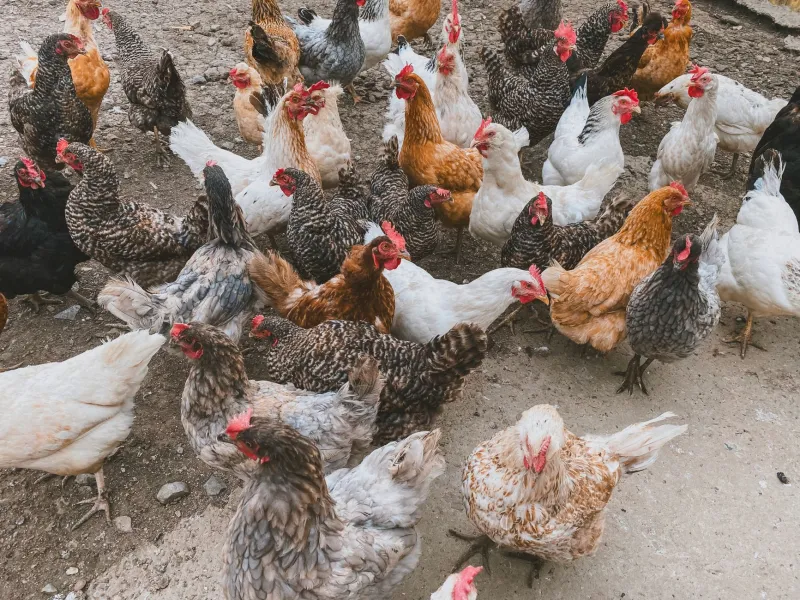
There is a generation of British people who have never tasted a proper chicken. Not a bad one, not an average one — simply no chicken with any discernible flavour whatsoever. They've eaten plenty of the things. Roasted them on Sundays, poached them into soups, sliced them cold onto sandwiches. But the bird they've been eating bears about as much resemblance to a real farmyard chicken as a beige carpet tile bears to a Persian rug.
This is not an accident. It is the result of fifty years of quiet industrial decisions that prioritised cheapness and speed over taste, texture, and basic animal welfare. The result sits in your supermarket chiller right now: a shrink-wrapped, bloated, breast-heavy creature that was alive roughly six weeks ago and has spent every one of those weeks indoors, moving as little as possible, eating processed feed, and growing at a rate that its own legs can barely support.
Britain eats over a billion chickens a year. The overwhelming majority of them are battery-raised, intensively farmed birds. And we've stopped noticing.
From Farmyard to Factory Floor
Cast your mind back — or ask someone old enough to remember — and the Sunday roast chicken was an event. Not a weekly default, but a genuine occasion. The bird would have been a dual-purpose breed, scratching around outdoors for months before it reached the table. It had muscle, because it had moved. It had fat distributed throughout the flesh, not pooled miserably in the cavity. It had flavour, because flavour comes from time and movement and a life at least partially well-lived.
The shift began in earnest in the 1960s and accelerated sharply through the 1980s, as supermarkets consolidated their grip on British food retail and began demanding birds that could be produced quickly, cheaply, and in enormous volume. Breeds like the Ross 308 — a broiler developed specifically for rapid growth and enormous breast mass — became the industry standard. These birds reach slaughter weight in as little as thirty-five days. Their muscles are pale and soft because they've barely been used. Their flavour is negligible because flavour takes time to develop, and time is the one luxury intensive farming cannot afford.
The price dropped. Demand soared. And gradually, without anyone quite deciding it collectively, the British public recalibrated its expectations downward.
What We Actually Lost
Ask a proper poultry farmer what the difference is and they won't mince their words. Dave Hattersley has been raising slow-grown, free-range birds on his farm in the Derbyshire Dales for twenty-two years. His chickens are a traditional breed — Label Anglais-style, raised outdoors for a minimum of eighty-one days. They cost roughly three times what a supermarket equivalent does.
"People come here and buy one, and then they ring me up," he says, grinning. "They ring me up to tell me it tasted like chicken. Which sounds daft, but that's genuinely what they say. They'd forgotten."
The difference isn't just flavour, though the flavour is remarkable — deeper, nuttier, with a richness that lingers rather than disappearing the moment you swallow. It's texture. Properly reared chicken has a bite to it, a firmness that tells you the muscle was actually used. It's also fat distribution: a slow-grown bird bastes itself from the inside, keeping the meat moist without needing to be injected with water and brine, which is standard practice in industrial processing.
And then there's the nutritional question, which the industry would rather you didn't ask too loudly. Research published in the journal Food Chemistry found that the omega-6 to omega-3 fatty acid ratio in intensively farmed chicken had deteriorated dramatically over several decades, largely as a result of grain-heavy, soy-based feed replacing the varied, foraged diet of a genuine free-range bird. You're not just eating less flavour. You're eating less of what makes the thing worth eating in the first place.
The Farmers Still Doing It Right
Hattersley is not alone, though sometimes it feels that way. Across Britain, a scattered network of small-scale poultry producers are raising birds the slow way, mostly selling direct — through farm shops, independent butchers, and farmers' markets — because the supermarket supply chain is structurally incompatible with what they do.
Sarah Okonkwo runs a small flock of Norfolk Black chickens in Suffolk, a heritage breed that was nearly extinct by the 1990s. Her birds roam genuine pasture, are fed a non-GM diet supplemented with whatever they find themselves, and live for around sixteen weeks. She sells them direct from her farm gate and through two local butchers.
"The supermarkets aren't interested," she says, without apparent bitterness. "They need consistency, volume, and a price point I can't hit. Which is fine. My customers know what they're buying and they come back every time."
That's the thing about proper chicken. Once you've had one, the supermarket version starts to feel like a peculiar practical joke — all that pale, yielding, flavourless flesh, releasing a small flood of water the moment it hits a hot pan.
Why We Keep Buying the Rubbish Stuff
The honest answer is price. A free-range, slow-grown bird will set you back anywhere between £12 and £25 depending on size and source. A supermarket own-brand chicken can be had for £3.50. For families managing tight budgets, that's not a lifestyle choice — it's arithmetic.
But for the significant portion of the population that could afford better and doesn't, the explanation is murkier. Partly it's habit. Partly it's the fact that supermarket marketing has been so effective at attaching words like "farm fresh" and "natural" to products that are neither. Partly it's that we've simply forgotten what the benchmark should be.
The food writer and campaigner Joanna Blythman has been arguing for years that cheap chicken is not actually cheap — that the cost is simply displaced onto the environment, onto animal welfare, and onto the long-term degradation of British food culture. She's right, and she's largely been ignored.
The Pig's Ear Verdict
Buy less chicken. Buy better chicken. This is not a complicated message, and it applies whether you're sourcing from a farm shop, an independent butcher who knows their supplier, or a local farmers' market. A genuinely good chicken, roasted properly with nothing more than butter, salt, and a lemon shoved in the cavity, is one of the finest things British cooking has to offer.
The watery, flavourless, battery-farmed version currently clogging the nation's supermarket shelves is not chicken in any meaningful sense. It is a protein delivery mechanism wearing a chicken suit.
Your nan's Sunday roast deserves better than that. So, frankly, do you.