Waxy, Rubbery, and Utterly Shameless: The Slow Murder of British Cheddar
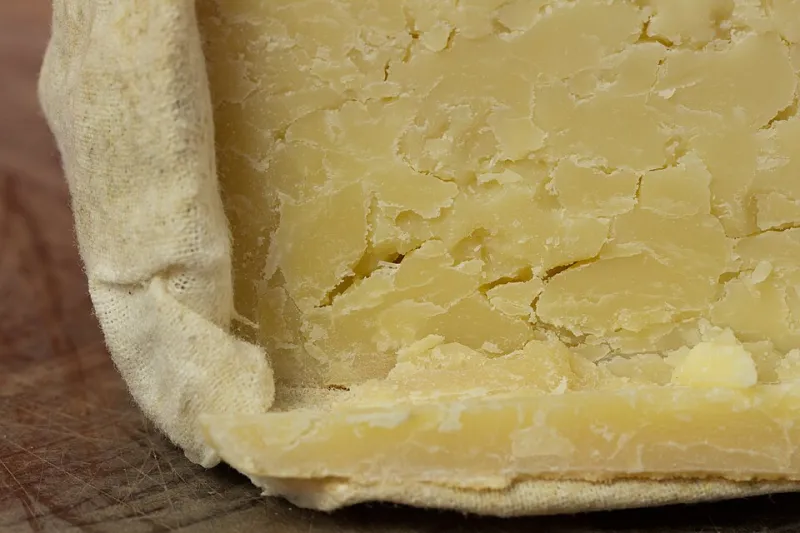
Photo: Ailura, CC BY-SA 3.0 at, via Wikimedia Commons
Let's start with a confession. There is, right now, in the back of your fridge, a half-eaten block of supermarket cheddar wrapped in cling film. It is the colour of a traffic cone. It bends slightly rather than crumbling. It smells of approximately nothing. You bought it because it was on offer — two for three quid — and because it called itself "Mature," which on a supermarket label means precisely as much as calling a Wetherspoons a "fine dining establishment."
You are not alone. Britain, the nation that gave the world one of its greatest cheeses, has somehow ended up eating an impersonator. A convincing-looking, aggressively marketed, technically-cheese-but-not-really impersonator. And we've been doing it for so long that most people under forty have never tasted the real thing.
This is the Great Cheese Slide, and it's been happening right under our noses — or rather, in spite of them.
What Proper Cheddar Actually Is
Real cheddar — the kind that has a right to call itself that — is made from unpasteurised milk, produced by hand in Somerset, and aged for at least twelve months. It crumbles. It has a sharp, complex bite with grassy, almost buttery notes underneath. It might have tiny white crystals in it, which are amino acids, and which are a sign that something genuinely interesting has been happening during maturation. It smells like a cave and a dairy and something vaguely ancient all at once.
There are fewer than a dozen producers making traditional farmhouse cheddar this way. Montgomery's in North Cadbury. Westcombe in Evercreech. Hafod up in Wales, doing a Welsh take on the form that'll make your eyes water in the best possible way. These are serious cheeses, made by serious people who have dedicated years to understanding what milk does when you leave it well enough alone.
The stuff in the supermarket is not this. It is factory-produced, pasteurised, pressed, and rushed to market in as little as three months. It is then labelled "Mature" or "Extra Mature" or, God help us, "Seriously Strong," and sold to a public that has largely forgotten there's a difference.
When Did It All Go Wrong?
The rot set in — ironically — around the same time Britain started getting serious about food. The post-war drive for cheap, consistent, widely available dairy products created the infrastructure for mass cheese production. Pasteurisation became standard. Milk pools from multiple farms got blended together, stripping out the regional character that made a Somerset cheddar taste different from a Dorset one. Factory presses replaced cloth-binding. Ageing rooms gave way to temperature-controlled warehouses optimised for throughput, not flavour.
By the 1980s, the supermarkets had cemented their grip on the supply chain. Price became the dominant variable. Cheddar became a commodity, not a craft product. The farmhouse producers who survived did so by finding specialist buyers — cheesemongers, restaurants, food halls — while the supermarket shelves filled up with the uniform, inoffensive, plasticky product that now accounts for roughly 70% of all cheese sold in the UK.
Seventy per cent. Let that sit with you.
The Cheesemongers Fighting Back
Walk into any decent independent cheesemonger — your La Fromageries, your Neal's Yard Dairy, your regional equivalents in York, Bristol, Edinburgh, Belfast — and you'll find people who are quietly furious about all of this. Not in a hand-wringing, artisanal-Instagram way. In a roll-up-your-sleeves, let-me-cut-you-a-proper-piece-and-change-your-life way.
"The tragedy isn't that bad cheddar exists," says one cheesemonger in Bristol who's been selling farmhouse varieties for over fifteen years. "It's that people think bad cheddar is cheddar. They come in and try a Montgomery's and they genuinely look shocked. Like, 'this is the same cheese?' And I have to tell them — no. It really isn't."
The small producers are equally blunt. Westcombe Dairy's cheese has won awards across Europe, but their output is a drop in the ocean compared to what rolls off the factory lines daily. "We can't compete on price," one producer explains. "We don't want to. What we're making takes time, skill, and decent milk. If you want cheap and cheerful, fine. But don't call it the same thing."
The Artisan Cheesemakers of the UK have been lobbying for stronger protected designation of origin rules — similar to what Champagne or Parmigiano-Reggiano enjoy on the continent — that would prevent the word "cheddar" from being slapped on anything that vaguely resembles it. Progress has been glacial. Turns out when the supermarkets are selling millions of units a week, they have a fairly strong interest in keeping things exactly as they are.
How to Spot the Real Thing Without Getting Fleeced
The good news is that genuine farmhouse cheddar is more accessible than it's ever been, and you don't need to spend a fortune to eat well. Here's what to look for:
Check the label for "unpasteurised" or "raw milk". This is your first filter. If it doesn't say it, it almost certainly isn't.
Look for cloth-banding. Traditional cheddar is wrapped in cloth during ageing, which creates a natural rind and allows the cheese to breathe. Factory cheddar comes in a wax rind or no rind at all.
Age matters, but so does how it's aged. "Mature" on a supermarket label often means six to nine months of cold storage. A proper farmhouse mature cheddar is typically twelve to eighteen months minimum, sometimes longer. Ask your cheesemonger — they'll tell you exactly how old it is.
It should crumble, not bend. Slice a piece and try to break it. Real cheddar fractures along crystalline lines. Supermarket cheddar flexes like a rubber band. If it bends, put it back.
Smell it. Proper aged cheddar has a pronounced, complex aroma — slightly tangy, a bit earthy, occasionally a hint of something almost caramel-like. If it smells of nothing, that's because it is, essentially, nothing.
Buy less, buy better. A 200g wedge of Montgomery's costs more than a 400g block of own-brand mature. But you'll use less of it — the flavour is so much more intense — and you'll actually enjoy eating it. That's the deal.
A Nation Worth Its Rind
Britain makes extraordinary cheese. Not just cheddar — Stilton, Cheshire, Red Leicester (the real stuff, not the orange dye job), Caerphilly, Wensleydale, Ogleshield, Stinking Bishop. We have a cheese culture that the French, for all their posturing, would recognise as genuinely serious if they could be bothered to look.
But we've let the supermarkets convince us that cheese is a commodity — something to be bought in bulk, melted on toast, and forgotten about. We've swapped flavour for convenience and called it progress.
Next time you're doing the weekly shop, walk past the yellow bricks in the chiller aisle. Find your local cheesemonger, or look online — Neal's Yard Dairy will post farmhouse cheddar to your door. Buy a piece that's been made properly, by someone who gives a damn. Eat it at room temperature, with good bread and a bit of pickle.
Then tell us, with a straight face, that it's the same thing.
It isn't. It never was. And the sooner we remember that, the better.