From Tin to Terroir: The Unlikely Gentrification of Britain's Greenest Side Dish
There is a tin in the back of every British kitchen cupboard. You know the one. It sits behind the condensed milk you bought for a recipe in 2019 and a jar of Branston that's seen better days. It is unassuming. It is olive-green. It has a small dent near the bottom and a label that has never once tried to impress you. That tin contains mushy peas, and for most of British culinary history, nobody thought to question it.
Then the gastropubs got involved.
The Original Article
Let's be clear about what mushy peas actually are before someone starts talking about provenance. They are marrowfat peas — a variety specifically bred to dry out, not to be delicate — that have been soaked, cooked until they collapse into themselves, and seasoned with salt. That's it. That is the whole recipe. In the north of England, particularly in Yorkshire, Lancashire, and Lincolnshire, they have been served alongside chips, pies, and battered fish for well over a century. They were cheap, filling, and required no culinary ambition whatsoever to produce. This was not a flaw. This was the point.
Chippy mushy peas arrive in a polystyrene cup or ladled into the corner of a paper tray with the structural integrity of warm wallpaper paste. They taste of salt, faint earthiness, and something you can only describe as green. They are not trying to be anything. They are, in the most honest possible sense, proper grub.
So why, precisely, has someone decided they need rescuing?
The Gastropub Gets Its Hands Green
Somewhere around the mid-2010s, mushy peas began appearing on menus in a form their ancestors would not have recognised. First came the crushed pea — a slightly chunkier, more textured cousin that made clear it had been to a farmer's market at least once. Then arrived the minted pea purée, which is essentially the same thing wearing a sprig of something as a hat. And then, inevitably, the truffle oil showed up.
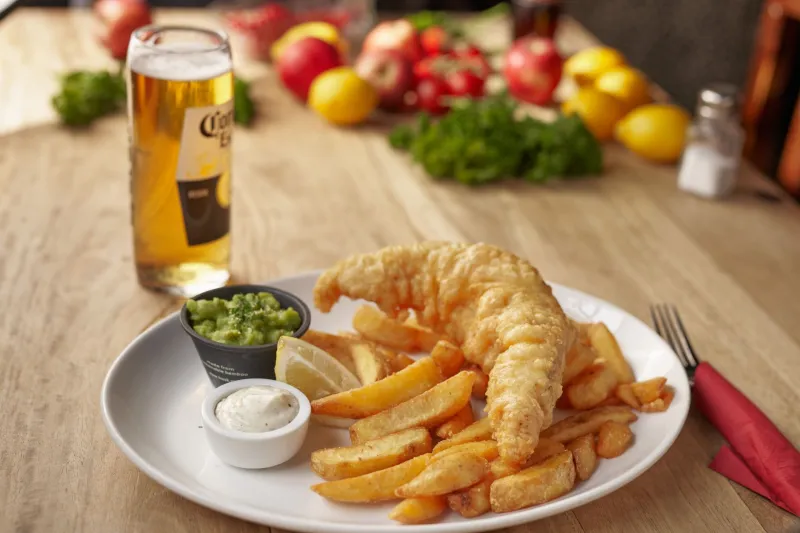
Walk into any gastropub worth its reclaimed timber and you'll find mushy peas listed not as a side dish but as an accompaniment. They come in a small copper pan or a slate-grey ramekin. They are garnished with pea shoots, micro herbs, or a smear of something that required a blowtorch. They cost £4.50. They are described on the menu as heritage marrowfat peas with garden herb oil and crispy shallots, and they taste — let's be honest — roughly the same as the tin, but with a faint note of anxiety about whether you've ordered correctly.
This is not progress. This is a rebrand.
The Defence of the Fancy Version (We're Trying to Be Fair Here)
Now, Pig's Ear is not entirely without sympathy for the chefs in this story. There is a reasonable argument that elevating a humble ingredient is a form of respect — that taking something overlooked and treating it with care is a worthy act. Plenty of British classics have benefited from a bit of considered attention. Black pudding is on tasting menus now, and nobody's crying about it.
And there are versions of the upgraded mushy pea that genuinely work. A good restaurant kitchen can coax real sweetness out of a fresh marrowfat, season it properly, and serve it alongside braised lamb in a way that makes you understand why someone bothered. Add a touch of mint — real mint, not a bottle of extract — and you've got something that complements rather than competes. That's cooking. That's legitimate.
The problem is not refinement. The problem is pretension dressed up as refinement. When a dish that costs pennies to produce is presented as a discovery — as if someone in a white apron has unearthed a forgotten ingredient from the British countryside rather than opened a bag from a cash-and-carry — something has gone a bit wrong in the honesty department.
What Gets Lost in Translation
Here's the thing about the tin that nobody in a toque wants to admit: it is consistent. Terrifyingly, reassuringly consistent. Open a tin of Batchelors mushy peas in Barnsley or Bournemouth and you will get exactly the same thing every single time. There is a comfort in that which no amount of pea-shoot garnish can replicate. It belongs to a category of British food experiences — alongside a bag of Tudor crisps at the bar or a Bird's custard poured straight from the jug — that are defined entirely by their refusal to be anything other than what they are.
Mushy peas from the chippy also come with context. They arrive at ten o'clock on a Friday night, eaten standing up on the way home, next to a cone of chips that's already going soggy. They are inseparable from that moment. No gastropub ramekin, however lovingly sourced, can manufacture that.
And let's talk about the mint sauce. In Yorkshire, mushy peas are traditionally served with a little pot of mint sauce on the side — the sharp, vinegary kind from a bottle, not a bespoke herb preparation. This combination is correct. It requires no improvement. Anyone who has replaced it with a drizzle of truffle oil has made a choice that reveals more about their priorities than their palate.
The Verdict from the Tin
Mushy peas do not need saving, elevating, or reimagining. They need to be left alone, served hot, and eaten without embarrassment. The best version is not the one with the most interesting provenance or the most considered garnish — it's the one that arrives in a polystyrene cup at a chippy counter run by someone who's been doing this for thirty years and has absolutely no interest in your opinion of their technique.
That said, if a good kitchen wants to make something beautiful out of fresh marrowfats and serve it alongside a proper main, fair enough. Just don't call it elevated. Don't put it on a slate. And for the love of everything green and good in this country, do not charge five quid for something that retails at 49p a tin and then describe it as artisanal.
Mushy peas are not artisanal. They are magnificent. There is a difference.
The tin is in the cupboard. It is waiting. It does not need your validation.